

In recent days, the systems underpinning our lives have become unreliable. And now companies’ technology problems have become the nation’s problem.
So far in November, Microsoft’s widespread cloud outage impacted many businesses, healthcare services and banks. Meanwhile, the FAA is still investigating the telecommunications failure that led to last Friday’s nationwide ground stop. On Monday, thousands of bank customers reported trouble with accessing their online accounts, and JP Morgan Chase later said these technical issues were due to a temporary “software bug.” Separately on Monday, United Airlines said a computer problem delayed departing flights. And on Tuesday, an Apple internal update caused App Store and service outages for customers, the tech giant said.
Despite seemingly logical explanations for these events, the successive system failures are worrying people online and leading to conspiracy theories about “blackouts.” The truth behind these recurring system outages has a more grounded explanation.
“I don’t think people need to worry that we’re under a cyberattack right now,” said Michael Chapple, a professor of IT, analytics and operations at the University of Notre Dame. “But it is raising some very legitimate issues about the fragility of our technology infrastructure.”
When so many online services rely on one provider, it can lead to cascading problems.
“What makes these failures so disruptive is how much depends on the same systems,” said Feng Li, associate dean for research and innovation at the Bayes Business School in City St George’s University in London. “You can switch from your bank’s app to its website and still be relying on the system that has just failed. A problem at one bank can also delay payments to customers at another.”
First, Check To See Whether A Cybersecurity Failure Is Actually Happening Or Not
Illustration: HuffPost; Photo: Getty Images
Cybersecurity experts expect these systemwide software outages to happen again –– so it’s best to be prepared for the next time your phone, app or computer starts showing a “system error” message.
“The timing of what’s happened this week has been coincidence more than anything else,” Chapple said. “But I think we are going to continue to see incidents like this occur because we just keep becoming more reliant on really complicated technology.”
Often, the first sign that something is wrong is when you can no longer access a service online. To double-check if it’s just you, visit Downdetector, a site that collects user reports of disrupted online services to see if the app you’re using was impacted. Just know that it may not tell the full story. “Downdetector counts user reports, which means worried users inflate the statistics during media events,” said Kayne McGladrey, a security expert and senior member of the Institute of Electrical and Electronics Engineers.
If you’re wondering whether a website is down, try looking up the site on a website service that tests availability directly, such as Is It Down Right Now. Apps may also maintain their own real-time status updates. In the case of Apple’s outage on Tuesday, users could look up the status of whether the App Store was working or not on Apple’s System Status page.
What You Can Do To Protect Yourself Against Cybersecurity Failures
The simplest and most important way to prepare for unexpected system outages is to create an internet backup plan and a money plan for emergencies, and to prepare travel contingencies for travel, experts said.
Tech
Many Outlook users couldn’t access their email inboxes during the Microsoft outage. If you have important contacts or information, this type of daylong inconvenience can become a headache. That’s why backing up your documents and contacts is so important.
To avoid losing access to your important documents, Chapple advised using synchronization tools to keep copies of what you are working on across multiple devices. For example, you can back up documents in a personal cloud storage space like Google Drive.
“You can store them in the cloud, but if you have those synced to your computer where you have working copies, then you’re able to keep going even when these systems fail,” he said.
Money
If your bank suddenly becomes inaccessible, would you still be able to pay for your rides or services in the meantime? If the answer is no, now is the time to create backups. Li said he advises having a backup card from another bank during online banking emergencies.
McGladrey said he keeps two to four weeks of cash in small bills and will spread his money across different institutions and payment methods, such as “a credit card from a different issuer, a debit card, and ideally a credit union account as a fallback” if one payment method fails.
“
Fake ‘account locked’ texts spike during events like this, so treat any unsolicited message about your accounts as hostile.
– Kayne McGladrey, security expert
McGladrey noted that FDIC-insured deposits at banks are covered up to $250,000. “The bigger risk is scammers. Fake ‘account locked’ texts spike during events like this, so treat any unsolicited message about your accounts as hostile,” he said. “If you need access immediately, go to a local branch or use an ATM. Otherwise, just wait. These incidents usually clear the same day. Scammers count on people panicking.”
“Unless you work there and need to fix it, just wait,” McGladrey advised. “Don’t resubmit transfers, as they may already be processing.”
And in general, people should be maintaining standard safety and security practices. Keep security features in your online banking turned on and use multi-factor authentication to protect your account. That way, “you’re keeping an eye on it, so you notice if anything unusual happens,” Chapple said.
APU GOMES via Getty Images
Travel
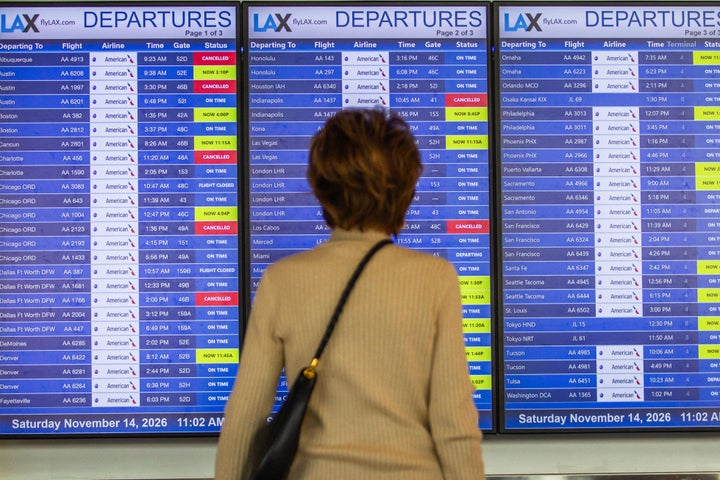
Flight delays due to technical issues have become increasingly common this month, and that’s why it helps to have your travel contingency plans ready in advance. Li advises turning on airline alerts and “leaving extra time if you have to be somewhere by a fixed date.”
“Leave buffer days around important trips, know your rebooking options, and insure expensive nonrefundable tickets,” McGladrey said.
If you have an important holiday trip coming up, ask yourself: “What if my air travel plans fall through? Could I rent a car or take a train or or do something else?” Chapple suggested. “The quicker you can react when something starts to go a little awry, the more likely it is you’re going to be successful rather than waiting in a really long line.”
Preparation Is Within Your Control When Outages Are Out Of Control
You can prepare for the worst and still be inconvenienced during a system outage. That’s normal. “It’s hard to to make yourself resilient against a major failure at a technology provider,” Chapple said. “You just have to take the risk that if my email is going to be down for a few hours, ‘Well, I’m going to have to do something else for a few hours.’”
Know that it should not be up to consumers alone to prepare for these cybersecurity outages.
“There’s only so much individuals can do. When essential services fail, regulators should get the evidence from operators, investigate what went wrong and explain their findings publicly,” Li said. “They should also check that backup systems work in practice and tighten the rules where needed to prevent a repeat.”

