

The latest personal assistants are powered by the most advanced artificial intelligence models ― and they also look adorable and cuddly.
In September, OpenAI’s rival Meta debuted its personal AI agent Muse. In a blog post, Mona Sarantakos, vice president of product management for Meta Superintelligence Labs, said designing an avatar and personality for Muse was a “delightful and most natural choice” because it felt less odd than chatting with “a corporate logo or entity.”
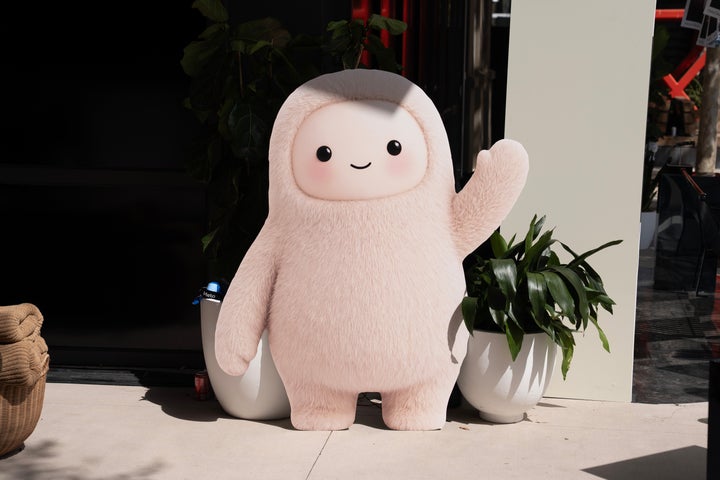
The tech giant debuted Muse’s mascot, Jolly, at its developers conference. With rosy cheeks, a fuzzy coat and a smiling round body, Jolly doesn’t appear like a stiff corporate representative. It looks like a friendly, giant stuffed animal.
The release of these agents arrives amid existential fears of AI’s power, which makes the cute appearance of these AI ambassadors notable. You don’t feel dread when looking at these new advanced AI agents. You might instead say, “Aw.”
In September, OpenAI announced that it would scrap its next-generation artificial intelligence model over deceptive behavior from the model, and that same week, it also introduced cute mascot blobs for its new personal AI agent: Dots. Dots’ mascots come in bright neon colors, wear sunglasses and bowties, and are named Iggy, Felipe, Jojo, Todd and Alfred. OpenAI told HuffPost, “Dots are an extension of you. Their visual identity is designed to reflect that, while making it clear that they’re AI agents.”
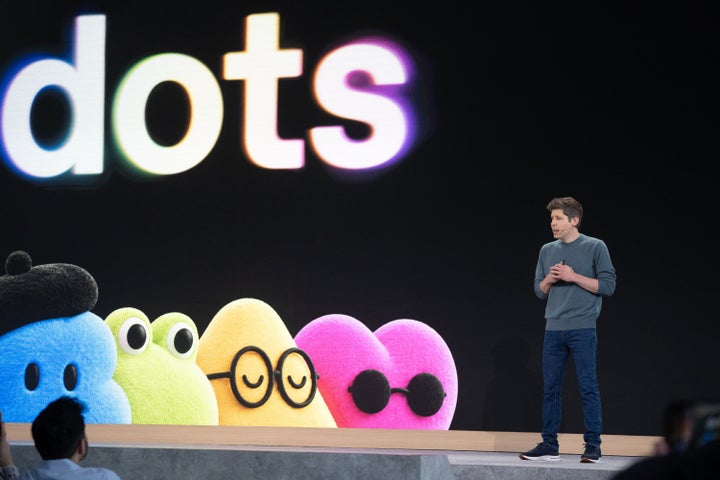
Bloomberg via Getty Images
Creating a cheerful anthropomorphic mascot for a product is a common marketing technique. To make car insurance less boring, there’s the Geico Gecko. To make learning a language feel less like homework, Duolingo has a bright green owl named Duo.
The difference is that these latest mascots are for next-generation AI agents asking for unparalleled access to your most sensitive data. In order to be useful as your assistant, these AI agents request data like your credit card, inbox, address and social media accounts in order to shop and make outbound phone calls to businesses on your behalf. In one ad for Jolly, the creature is smiling and waving with a paw while the caption states, “Let Muse shop for you.”
The cute design of AI agent mascots “can trivialize the handing over of personal and private data by lulling users into thinking that they are simply extending a longer leash to their beloved pet,” said S. Shyam Sundar, a professor and the director at the Penn State Center for Socially Responsible Artificial Intelligence. “In reality, this pet-like agent is furiously gobbling up all your data and interacting with a whole host of other agents that are invisible to the user in accomplishing the tasks assigned to them.”
In response to the criticism around the design, OpenAI told HuffPost that Dots are restricted to adults, and users don’t have to pick a character or give their dot a name to get started. Meta did not respond to HuffPost questions about the design choices of Jolly.
The Cuteness Of AI Agents Provokes A Unique Response In Humans
Bloomberg via Getty Images
Muse is restricted to adults aged 18 and over, but its default mascot, Jolly, has a cute design similar to a child’s toy. Jolly’s wide forehead and widely spaced eyes follow a known taxonomy of cuteness that could trigger a caregiver response in users, said Zoe Fraade-Blanar, co-founder of the international toy brand Squishable and co-author of “Superfandom: How Our Obsessions Are Changing What We Buy and Who We Are.”
“You can’t be taught by a baby, or something that has baby-like characteristics. It’s much easier to feel ‘I’m still in charge, but we’re going to do this together,’” Fraade-Blanar said. “It’s not a teacher. It’s not an authority figure.”
This nonthreatening approach to these agents’ design matters, because humans don’t respond well when they are being judged by online assistants. Fraade-Blanar cited Clippy, Microsoft’s former office assistant that looked like a simple paperclip but provoked widespread backlash for sounding judgmental and like it knew better than humans. These latest AI agents, in contrast, look helpless.
Take Jolly having mittens instead of hands or fingers. Fraade-Blanar said this design choice is significant. “The fact that these hands are too big and clumsy to actually do anything by themselves, it’s really broadcasting that idea of ‘You’re [in] control here. I’m not going to do anything without your say-so. I’m just a baby. I need your help,’” Fraade-Blanar said.
Meanwhile, Dots’ Alfred has a professorial look with eyeglasses and a bowtie. “Alfred is leaning into the concept of ‘I’m here to serve you. I’m here to help you. You’re in charge. You are the employer; I’m just the butler,’” Fraade-Blanar said.
Cuddly AI Agents Feel Less Threatening. But Don’t Forget What These Agents Can Do.
It’s normal if you have warm and sympathetic feelings toward a fuzzy, round AI agent. Research has found that we perceive human qualities in machines that they don’t actually have.
Despite whatever warmth you may feel toward these agents, remember AI isn’t a person. AI is “basically a camera and a microphone that’s extending a thread of a corporation into your home,” said Joanna Bryson, an AI scholar and professor of ethics and technology at the Hertie School in Berlin.
Be cautious of answers you get from a personal AI agent despite the disarming cuteness of the messenger. Bryson noted that people can hold what is known as a computer bias. “So they tend to believe computers over humans, even if the computer is completely wrong,” she said.
Moreover, don’t forget the capabilities of an AI agent with access to your personal information. In terms of what these agents are trying to do, “putting a cute mascot on it doesn’t actually change what it’s doing any more than putting a name on a hurricane changes the strength of the hurricane, but it does change how we react to it,” Fraade-Blanar said. “It could easily lull us into taking potential downsides much less seriously. You don’t have to be afraid of a baby.”
Meta and OpenAI both have a track record of creating privacy concerns with their products. In one recent case, a Muse agent mistakenly shared the home address of a tech reviewer to a prospective Facebook Marketplace buyer. The buyer then “showed up without it even telling me until late tonight that it messed up,” the reviewer recounted on social media.
“Only history is going to tell whether or not these tools are positive or negative. But however it turns out, we need to keep in mind at all times it’s not a baby,” Fraade-Blanar said, noting that “even the cutest mascot can’t make up for a tool that doesn’t work.”

